The Vatican Museums occupy over 7 kilometers of galleries. You cannot see everything in one visit. Most first-time visitors spend three to four hours inside, which is enough to cover the highlights without complete exhaustion.
The museums close on Sundays except the last Sunday of each month, when admission is free. That free Sunday draws enormous crowds. Regular tickets cost around $20, or about $30 for skip-the-line access.
The entrance is on Viale Vaticano, a ten-minute walk north of St. Peter’s Square. Metro line A to Ottaviano-San Pietro gets you close. Arrive at opening time (9am most days) or after 2pm to avoid the worst lines.
The Sistine Chapel
Most visitors come for the Sistine Chapel. It sits at the end of the standard route through the museums, which means you’ll walk past many other galleries first.
Michelangelo painted the ceiling between 1508 and 1512, then returned decades later to paint The Last Judgment on the altar wall. The chapel still functions as the papal conclave meeting room where cardinals elect new popes.
No photographs allowed inside. Guards enforce this. The chapel gets packed by midmorning, with hundreds of people standing shoulder to shoulder. If you want a few minutes of relative quiet, arrive right when the museums open and walk directly to the chapel using the shortest route.
The museums offer an audio guide for about $8 that covers the major rooms, including detailed commentary on the Sistine Chapel frescoes.
Raphael Rooms
The Stanze di Raffaello (Raphael Rooms) come just before the Sistine Chapel on the standard route. Pope Julius II commissioned Raphael to fresco four rooms in the papal apartments starting in 1508.
The School of Athens fresco in the Room of the Segnatura shows philosophers and mathematicians from classical antiquity gathered in an imagined ancient hall. Raphael painted his contemporaries into the scene—Michelangelo appears as the philosopher Heraclitus, and Leonardo da Vinci as Plato.
These rooms stay slightly less crowded than the Sistine Chapel, and you can photograph them.
The Gallery of Maps and Other Highlights
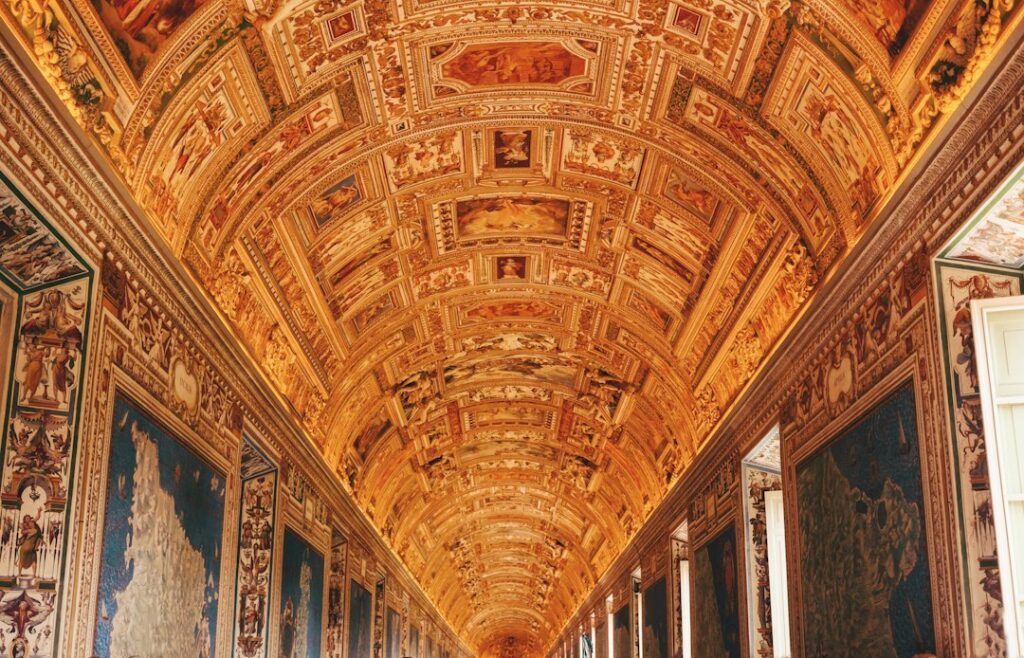
The Gallery of Maps (Galleria delle Carte Geografiche) runs 120 meters long, with 40 topographical maps of Italian regions frescoed on the walls in the 1580s. The ceiling frescoes get less attention but reward a look upward.
The Pinacoteca (picture gallery) holds paintings from the medieval period through 1800. Caravaggio’s Deposition hangs here, along with Raphael’s final painting, the Transfiguration. This gallery sits in a separate building and many visitors skip it entirely, which makes it a quiet place to spend thirty minutes.
The ancient sculpture collection fills dozens of rooms. The Laocoön and His Sons, discovered in Rome in 1506, sits in the Octagonal Courtyard. The Apollo Belvedere occupies the same courtyard. Both sculptures influenced Renaissance artists profoundly.
Practical Tips
Book tickets online in advance. The museums sell out on busy days, particularly in spring and fall. Viator offers skip-the-line tickets and guided tours if you want commentary beyond the audio guide.
Wear comfortable shoes. The floors are hard marble and you’ll be walking and standing for hours.
There’s a cafeteria inside the museums and a self-service restaurant, both overpriced but convenient if you need a break. You cannot leave and re-enter on the same ticket.
The museums operate a strict one-way route on crowded days. You cannot backtrack easily. If you want to see something twice, note its location and return if time permits at the end.
On Wednesday mornings, papal audiences take place in St. Peter’s Square. This affects crowd levels and access routes around the Vatican. Check the schedule before you visit.
The Vatican sits entirely within Rome but operates as an independent city-state. Different rules apply inside—dress modestly with knees and shoulders covered or you’ll be turned away at the entrance.
For more detailed guides to Rome and the rest of Italy, subscribe to The Ultimate Italy Travel Guide newsletter. We send one free letter every Friday with practical advice for planning your trip.
Heads up — some links in this article are affiliate links. If you sign up through them, we may earn a small commission at no extra cost to you. We only recommend tools we use ourselves.
Tours & experiences in Italy


Powered by Viator. Some links are affiliate links — we may earn a small commission at no extra cost to you.